Showing posts with label Randle Farms. Show all posts

Monday, September 19, 2011

Almost Vegetarian Shepherd's Pie

I LOVE the change of seasons. Autumn means we can say good-bye to the stifling, humid, disgusting temperatures of summer and say hello to cool mornings, pleasant days, and warm comfort foods. This week when planning the menu, I consulted weather.com to see just how warm and comfortable I could get with supper. Then, I pointed my browser to epicurious.com and found Vegetarian Shepherd's Pie from Gourmet 2009. Perfect, except for the fact I had 6 butternut squash sitting on the counter and more than 1/2 lb. of opened ground beef from Randle Farms sitting in the fridge. Oh, and a container of rabbit stock I made a couple of months ago. Time to improvise.

I gathered the essential vegetables: shallot, garlic, leek, parsnip, carrot, baby bella and shiitake mushrooms, and a butternut squash weighing just under 1 pound. If you've worked with vegetables, you know prep work can be the most time-consuming aspect of a recipe.

Though I took several liberties with this recipe, I was giddy with excitement when read that I would be making a sauce with a red wine reduction, my delectable rabbit stock, and a beurre manié, which is simply equal parts butter and flour kneaded together to act as a thickening agent in a sauce.

Here I must digress ever so slightly. I've learned a bit about stocks and sauces while reading the culinary text Professional Cooking by Wayne Gisslen, as well as in reading Julia Child's My Life in France and Kathleen Flinn's book The Sharper Your Knife the Less You Cry. Stocks are called fond in French because the French see them as the foundation of any sauce or soup, and an excellent foundation makes for an excellent end product. I began making stock about a year ago so that I wouldn't have to buy the organic broths at about $3.50 a pop; however, I dump all manner of vegetable bits and peels to make my vegetable stock. Ohhhh, but how Julia and the great chefs would gasp–in her book, Julia nearly cries over the loss of a perfect veal stock. I can see now how my haphazard way of making vegetable stock leads to a very unpredictable end result. I'll work on that. Sauces, according to either Child or Flinn, came about to mask otherwise questionable meat. I say all this to preface the fact that my rabbit stock was divine and imparted a most wonderful flavor to this dish.
But, I'm becoming long-winded.

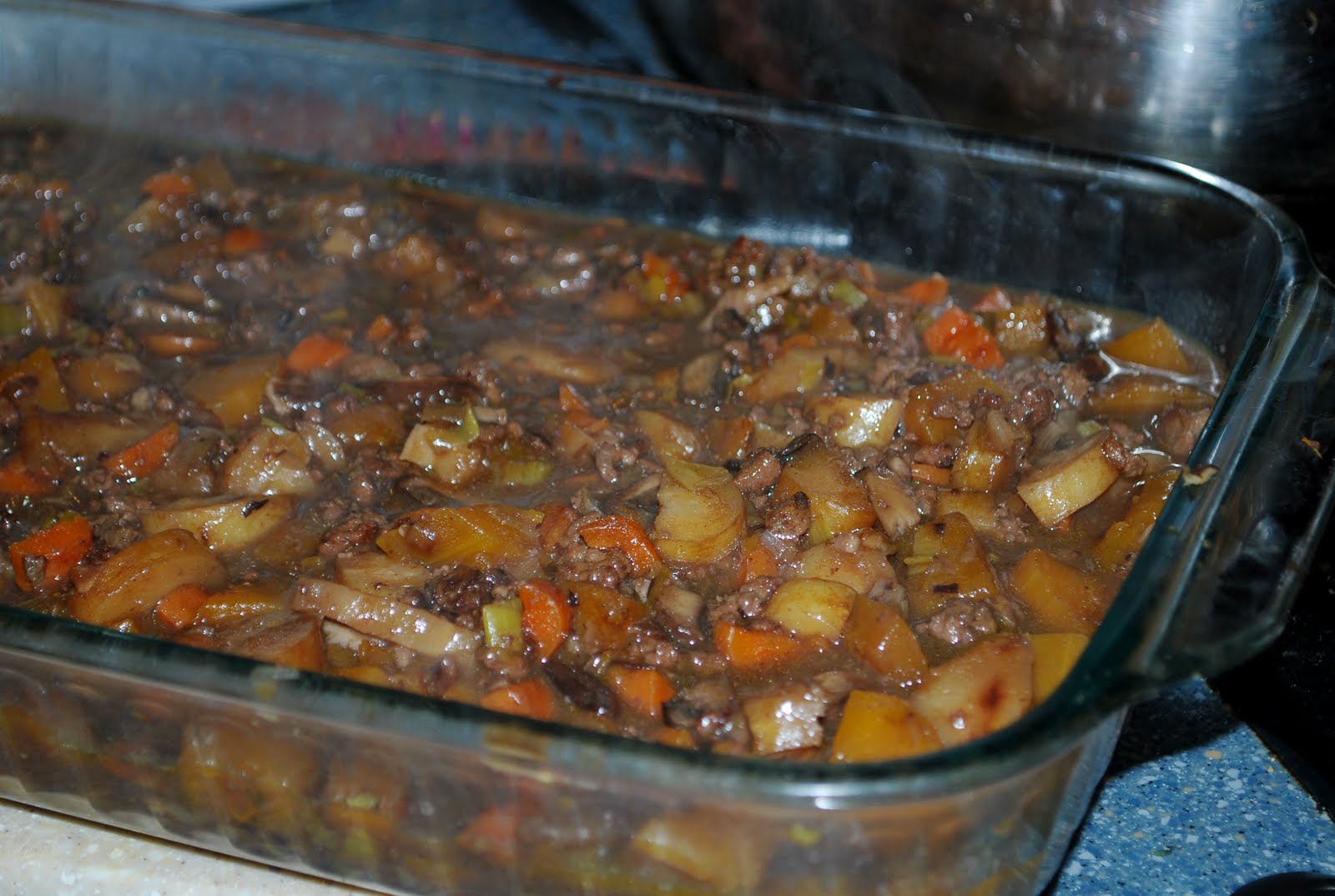
After reducing my wine, adding the broth, and whisking in the beurre manié, I had this beautiful, velvety sauce to simmer my veggies and ground beef in for about 25 minutes. I must say, this was the best gravy or sauce or whatever it is that I've tasted, and I think it can be attributed to a solid fond and the beurre manié.

Unlike most Shepherd's Pie, which feature ground lamb and a final bake in the oven, this dish is ready once the potatoes are added. If you're making this, be sure to find a broiler-safe casserole dish. My dish was not, and I could not pop it beneath the broiler to brown the potatoes–which, by the way, are made with a generous slathering of butter and cream.

If you would like to follow the original recipe, click the link above, otherwise follow my adaptation below. Whatever you do, keep the technique of beurre manié close at hand for your next sauce or gravy.

"Almost Vegetarian Shepherd's Pie"

2 shallots, minced
3 tablespoon olive oil, divided
1/2 pounds ground beef (optional)
1 medium leek (white and pale green parts only), halved lengthwise, sliced 1/2 inch thick, and washed
4 garlic cloves, chopped finely
1 cup mushrooms, trimmed and quartered (I used a combination of shiitake and baby bellas)
3 medium carrots, cut into 3/4-inch-thick half-moon pieces
3 medium parsnips, cut into 3/4-inch-thick half-moon pieces
2 tablespoons thyme leaves
1 tablespoon chopped rosemary
3/4 bottle Cabernet Sauvignon
3 tablespoons salted butter, softened
3 tablespoons all-purpose flour
4 cups hot rabbit stock (you can substitute for the stock of your choice)

For Topping

3 pounds red potatoes
1/2 stick butter
1/2 cup skim milk
1/2 cup heavy cream

1. Prep all vegetables.
2. Brown ground beef. Transfer to a plate.
3. Add about 2 Tablespoon olive oil and cook leeks over medium heat until softened, about 6 minutes. Throw in a pinch of salt. Add garlic and cook, stirring often, until slight color appears. Add 1 Tablespoon of olive oil and add mushrooms, stirring, until golden, about 5 minutes.
4. Add carrots, parsnips, butternut squash, thyme and rosemary. Cook, covered, stirring occasionally until vegetables become tender, about 10 minutes. Transfer vegetables to a bowl.
5. Add wine to pot and boil until reduced to about 3/4 cup, 10 to 15 minutes.
6. While wine reduces, briskly beat together flower and butter in a small bowl until it forms a paste (beurre manié).
7. Add stock to wine reduction and bring to a brisk simmer. Whisk in beurre manié 1 Tablespoon at a time, whisking briskly to thoroughly incorporate with the liquid. Continue whisking until mixture thickens, 3 to 5 minutes. Add ground meat and vegetable mixture to pot and simmer, covered, 25-30 minutes.
8. While mixture simmers, peel potatoes and cut into 2-inch pieces. Cover potatoes with cold water and simmer, partially covered, until very tender, 20 to 25 minutes. When ready to mash, add 1/2 stick butter, cream and milk. If you have a food mill or hand mixer, mix until creamy; otherwise, just mash and beat until very smooth.
9. Put meat and vegetable mix in broiler-proof dish, top with potatoes, and heat 3 inches under broiler until potatoes are golden brown.

Bon appetit!

Sunday, September 18, 2011

Granola Girl

Jarred Diamond, author of Guns, Germs, and Steel, says that civilization advanced in the Middle East (to begin with) and spread because of cereal grasses. Catch the second episode in the series on Netflix for more information. He was specifically talking about wheat and barley, but I would like to pay homage to the another cereal grass: oat.

I've enjoyed eating oats since a child when Grandma Kiser would cook rolled oats for breakfast, laced with sugar and whole milk. MMMM. These days I prefer my oats as a topping for granola, and I must thank an unusual source for my new favorite breakfast food: McDonald's. Read closely because this will be the only time you'll ever hear me say a good word about McDonald's. While I understand they are not the cause of what is wrong in the food world, to me, they at least represent all that is wrong with food in the world: big agribusiness, CAFO's (Concentrated Animal Feeding Operations), government subsidies that make bad-for-you-food affordable and healthy fresh fruits and vegetables less so. I could go on, but I've promised myself I would rant less here.

Why do I credit McDonald's with my love of yogurt topped with granola? Like many people, I left the house one morning without breakfast and was starving, so I stopped at the golden arches looking for the least bad-for-me item on the menu. I saw yogurt, fruit and granola on the list and bought one. It was the last one I ever purchased, but I started making my own granola and topping it with frozen fruit. McDonald's had a good idea, but they put too much sugar in theirs, beginning with the flavored vanilla yogurt and continuing with sweetened berries. Plus, it was way too small.

Initially, I was buying granola from Day Spring, but even their granola seemed to have too much sugar in it for our liking. I searched through cookbooks and Epicurious.com to find a recipe. Now, granola is one of the few things I can make blind-folded because it's one of the few things I make over and over again.

1. Preheat your oven to about 4oo degrees, I make mine 410 because it seems to work better.

2. In a large bowl, I mix 4-1/2 cups of oats. I'm not sure if they're quick cooking or old fashioned because I buy them in bulk at Earth Fare. To this I add 1/4 cup flax seed and 1/4 cup wheat germ. Mix it up.

3. While your oven is heating up, get a small saucepan and add the following:
3 Tablespoons butter, 1/2 cup orange juice, 1/4 cup cane sugar (I had to use molasses for this batch as I was out of cane syrup), 1/4 cup raw local honey (just because it tastes better. I buy mine from Bee-Mac Apiaries on Waverly Parkway at the home of Mr. and Mrs. Ben McGehee), and 1 teaspoon vanilla flavoring. I used to use vanilla extract until I read that high temperatures evaporate too much of the goodness from real extract. Now I save the real thing for baking.

4. Thoroughly mix the liquid into the dry ingredients before spreading onto a baking sheet and top with your choice of nuts. For this batch, I used slivered almonds. Set your timer for 15 minutes and wait. When the timer goes off, stir the granola so that more of the mixture gets exposed to the heat. Set your timer for 5 minutes. You keep doing this last step until the granola is the texture and color you desire. For this amount, it took three repetitions of stir and wait.

Voila! Now you're ready to put the finished product in an air-tight container and enjoy yogurt and granola for the rest of the week.

I like to use Greek yogurt because it tastes richer and more satisfying to me. We top our yogurt and granola with organic blueberries or raspberries since berries are some of the most pesticide-laden fruit. We're using the last of the summer berries I picked at Randle Farms in Auburn.

Bon appetit!

Tuesday, May 17, 2011

Food Values

Maybe I should take it as an omen that the draft I began and hoped to post yesterday disappeared, but I want to continue with ideas from Diet for A Small Planet by Frances Moore Lappe, who excitedly wrote about the food revolution she saw emerging in the early 1990's. I was busy with children and college, so I don't recall any great food revolution, and I'm not entirely convinced that the revolution grew or was sustained. I think for there to be a true food revolution, we Americans will have to rethink our values surrounding food.

For example, it seems that Americans, in general, don't want to spend a lot for food--we don't value food and farmers (not agribusinesses, but farmers). Americans, in general, want to spend money on things, maybe because they are tangible and food is gone once it's consumed. Hans Herren, president and CEO of Millenium Institute, spoke of "cheap food" during the Washington Post Live: The Future of Food Conference earlier this month. Follow the link to see video clips of speakers and panels. I quote Herren, whose institute's mission is to manage economy, environment, and sustainability for the benefit of all: "This idea that it's a God-given right for cheap food has to go. ... We have to produce more foods in different places, by different people. We have to deal with externalities which will take political courage, which I haven't seen here today."

The externalities he speaks of are the hidden costs to individual health and the environment, and access to food. I couldn't agree more with his entire statement. It will take courage and a re-vision of our values. It will take what Lappe calls citizen democracy, which she says is values-driven problem solving and empowerment through action, our action.

"Thus, citizen democracy is not about learning to give up one's interests for the sake of others. It is about learning to see one's self-interests embedded in others' interests." (Lappe xxxv)
I think that everyone could agree clean water, access to good food, food safety, a healthy environment, and a decent wage are in everyone's interest. Apply that to food and food production, and we can see that producing food in a way that protects the integrity of the environment and the food itself, as well as protecting those who grow, harvest, and eat that food, is also in everyone's best interest.

Believe me, I haven't--and may never--reach the point where my values around food keep me from buying coffee and wine, flour (though looking at farm subsidies in Alabama, it seems we grow wheat in the state), lemons, and the occasional exotic ingredient. But I can say with all honesty that my "food values" continue to evolve, and I'm willing to invest my dollars and cents toward those values.

When my children were growing up, I spent money on good foods--fruits, milk, vegetables, grains. There wasn't a lot of money to spend, and snack food, trips to McDonald's, sweetened cereals, and pop were rare treats. Ask them; these items were so rare, the girls say they were "deprived" of them. I've always believed in spending money on healthy food first and everything else second.

About six years ago after reading The Omnivore's Dilemma by Michael Pollan, I began to see that industrial farming wasn't good for me, and it wasn't good for nature (include the environment and the animals that wound up on my plate). I quit eating meat, and I bought eggs at Dayspring because they came from a small farm in Tallapoosa County.

The next "stage of evolution" happened gradually as I learned about agribusiness (Monsanto, ConAgra, Archer Daniels Midland, and their ilk) and how their practices endangered the environment, people's health, and access to food by patenting and controlling the seed used for growing food. I learned about Randle Farms in Auburn two to three years ago, and I began participating in the farm's Consumer Supported Agriculture. Randle Farms patterns its practices after Polyface Farms, which is featured in The Omnivore's Dilemma. I liked that I was able to find a source of vegetables, fruits, eggs, and meat that was produced with respect to the animal and the land AND that supported a local farming family, not agribusiness. It is a little more expensive, and I'm fortunate that I can participate in the CSA. Perhaps more people would be able to access good, healthy, local food if farm subsidies didn't go almost exclusively to commodity crops (which are among the first crops to be genetically engineered).

Now, Anthony and I are trying to grow some of our own food. The garden is looking good so far. Beets can be harvested in just a few days and potatoes in a week or two; we've already been picking tomatoes. I'm eyeing a patch of soil to start asparagus next year because I love asparagus, but I just can't buy something that is shipped from Peru, produced by God-knows-what methods, when I know it can be grown in my region.

My little family alone isn't going to solve all the issues associated with industrial vs. sustainable food production, but that won't stop us from doing our part. As our oldest daughter says, "If everyone would quit saying they can't change everything and just DO something, things would change."

Tuesday, April 19, 2011

The Meat of the Matter

After reading Michael Pollan's book The Omnivore's Dilemma several years ago, I decided to give up meat for Lent. It stuck for two or three years after that, and I never missed a bite; well, maybe I missed a lovely medium-rare steak every now and then. Then I met Anthony and rejoined the meat-eating world. We only ate chicken because we deluded ourselves into believing that organic chicken, free of hormones and antibiotics, was good food.

For the past eight months, we have limited our meat consumption mainly to the 16 pounds we get each month from Randle Farms' meat share with an occasional trip to the meat counter at Earth Fare. We like that the animals on Randle Farms graze on grass-covered hills in a large pasture, that they aren't pumped full of antibiotics and other drugs to make them grow faster, and they aren't fed food that wasn't meant to be eaten by them.

The news this week about bacteria inhabiting the meat we buy at the grocery store--all manner of meat--suggests organic is a little better for you, and local, farm-raised meat is even better.

On April 15, Time posted, "What's Lurking in Your Meat and Poultry? Probably Staph" that reported on a study by Lance Price, a professor at the Translational Genomics Research Institute. Price began the study when he noticed reports of farm workers picking up staph infections from the animals, and he wondered how this affected the meat from those animals once they were slaughtered. The results of the study indicate you're likely to bring home something extra with your beef, pork, and poultry: consumers purchasing meat at the grocery store have a one-in-four chance of bringing home meat contaminated with a strain of staphylococcus aureas resistant to three classes of antibiotics. We can now add staph to the list of bacterial contaminants we've become familiar with in our food: E coli, listeria, and salmonella. Yum.

The Christian Science Monitor posted an article one day later, "Staph in meat. Are US cattle and poultry over drugged?" This article put a precise number on the study: 47 percent of the meat and poultry sampled was contaminated with staphylococcus aureas, half of which was resistant to three classes of bacteria. In this article, Prince clearly states the problem is a result of how antibiotics are used in food-animal production. He continues to say that proper cooking of the meat kills the bacteria, but I like my cow nearly mooing when it reaches the plate. I don't see why I should have to kill the steak twice when contamination occurs in the "production" process. Oh, and guess what? The National Cattlemen's Beef Association questions the study and called it's findings irresponsible. Isn't that a surprise. Again, I point to Eric Schlosser's Fast Food Nation and Upton Sinclair's The Jungle to get a glimpse into the conditions factory farmed animals live in and are slaughtered in. Pollan may also address this in his book.

Another survey of chicken in Seattle grocery stores found similar results: 42 percent of the chicken sampled contained staphylococcus aureas, and a host of other bugs. You can read it on the Marler Blog. Bill Marler is a lawyer who began prosecuting cases of foodborne illness in 1993 and runs a blog about food poisoning outbreaks and litigation.

While surfing the net to find these stories and related material, I also came across "Egg recall: DeCoster-linked farm releases contaminated eggs. Again" in The Christian Science Monitor. A "megafarmer" Jack DeCoster, as the Monitor describes him, was involved in a 550 million egg recall from retailers in Arkansas, Illinois, Iowa, Kansas, Missouri, Oklahoma, and Texas. The article is dated Nov. 9, 2010. Don't breath a sigh of relief just yet; DeCoster has been cited at least three other times for problems ranging from how he cares for his animals to how he cares for his workers. Iowa named him a habitual violator, so it's likely he'll strike again. He may not sell his eggs in Alabama, but I'm willing to bet there's another DeCoster out there who does.

So, the moral of the story? We have to care more about the food we eat and how it's raised--I say raised rather than produced because these are animal products, and I still prefer to refer to them as animals rather than products. Americans balk at spending more for food; we'd rather have big screen TV's and drive gas-guzzling SUV's. Okay, a generalization that isn't fair to all, but we do spend less per capita on food than most nations. A report by Rosen and Meade on Askville by Amazon states: "Within each income group, percentages differ considerably (table 1). Residents of Canada, Luxembourg, and the United Kingdom, like the United States, spend less than 12 percent of their PCE on food. Among the 24 countries in the high-income group, 5 spend more than 20 percent of their PCE on food, with the highest share held by Israel (22 percent)"(see the figures here and read here). We have to stop believing that big corporations, "megafarmers" and government agencies have our health and welfare as their top priority. They don't.

I feel very fortunate that I can buy my meat and eggs from farmers I know and talk with, whose animals I see in the fields. (The steaks in the photo are from Randle Farms.) I'm also glad Auburn is home to places like Blooming Colors and Dayspring; both businesses sell eggs gathered by local farmers, and Blooming Colors sells a variety of locally grown vegetables. Supporting local farmers and businesses is good them, and it's good for consumers.


Thursday, April 7, 2011

Strawberries-Yum?

Who doesn't love strawberries? They're like little bursts of sunshine in your mouth when just picked and a flashback to summer when eaten in ice cream or jam. We planted eight a week or so ago, which I think is half the number we really need, but I wanted to grow some as summer treat without having to worry about pesticides.

Wednesday, I picked up our meat share from Randle Farms and saw white buckets brimming with gorgeous, red berries--pesticide free. I wish I had taken my camera with me. Maybe I'll learn.

Seeing those beautiful berries piqued my curiosity about just how tainted with pesticides most commercially-grown strawberries are, so I did a little surfing to see what I could find.

Googling strawberries and pesticides produces pages and pages of hits from 2010 related to strawberries, California, and methyl iodide. I did a second search adding "2011" to find more current information, too. A New York Times article from June 2010, "Dispute Over Pesticide for California Strawberries Has Implications Beyond State," details the battle between the California Department of Pesticide Regulation and a scientific review committee over the approval of methyl iodide, evidently it is a battle still not settled. Outgoing Gov. Arnold Swarztenegger approved its use, and California farmworkers and environmentalists filed a lawsuit in December 2010 to prevent its use. Not to worry though, the website American/Western Fruit Growers quotes a spokesman for the company that produces the pesticide saying the lawsuit will have no affect on the "roll-out" of the product. The same article also devotes space to "Methyl Iodide Misconceptions." And who points out these misconceptions? The very same spokesman for ArystaLifeScience, the pesticide producer.

According to the NYT article and an online article from Rodale, California grows 90 percent of the nation's strawberries. Strawberries have a long association with toxic chemicals. Growers used to treat the ground, before planting, with methyl bromide until it was found that this particular chemical, along with being toxic, was detrimental to the ozone layer. Methyl bromide is being phased out and methyl iodide is being phased in.

This new chemical seems to have a mixed review. There are scientists who say methyl iodide is far too dangerous to be approved for use. Some California farmers, according to the article, are in favor of approval and believe California's strict regulations would be enough to insure that prescribed use of the chemical will be safe for all--farmers, workers, consumers, people who live in close proximity to treated farms.

Rodale published an online article, "Coming Soon to Your Strawberries: Newly Approved Carcinogenic Pesticide," which lists some of the specific health problems associated with the chemical methyl iodide. The article quotes Susan Kegley, PhD, founder of the Pesticide Research Institute, saying, "The methyl group can affect your DNA and change the way your genes function." Methyl iodide has been linked to miscarriages and thyroid disease and is listed as a carcinogen in California. Hmmm. Despite this, 47 states have registered this chemical for use. In addition to strawberries, the Rodale article says that methyl iodide is also used on tomatoes, peppers, and nursery crops. Florida is one of those registered states and a supplier of strawberries to grocery stores in Alabama. The article raises a number of interesting questions about the long-term effects of this chemical, which, by the way, must be applied by persons wearing protective gear with respirators.

As I said, there are pages and pages of hits when one searches for strawberries and pesticides. Don't take my word for it, and don't take the word of pesticide producers or the FDA. Investigate for yourself. Here are three more links to get you started: An online article from March 2011, "The Midas Touch, The Midas Effect," from Monterey County Weekly; articles about methyl iodide collected on the ANR News Blog (Agriculture and Natural Resources by the University of California); and a March 2011 online article from Change.org, "EPA to Re-examine Carcinogenic Pesticide, Methyl Iodide?"